-
Shop
- Advanced Technologies
- AI Career Advantage Collection
- Apple Accessories
- Bathroom
- Best Sellers
- Black Friday Sale
- Car Accessories
- Digital Products
- Digital Resources
- Fashion
- Furniture
- Gadgets
- Gift Ideas
- Health & Beauty
- Home
- Home & Garden
- Home Decor
- Home Electronics
- Home Supplies
- Independence Day
- Kitchen
- Lighting
- Mother’s Day
- Patio, Lawn & Garden
- Pet Supplies
- Pets
- Samsung Accessories
- Special Deals
- Sport & Outdoors
- Super Deals
- Travel & Outdoors
- Watches
- New arrivals
- Featured
6–50 mm² Lug Crimper: Clean Heavy-Cable Connections
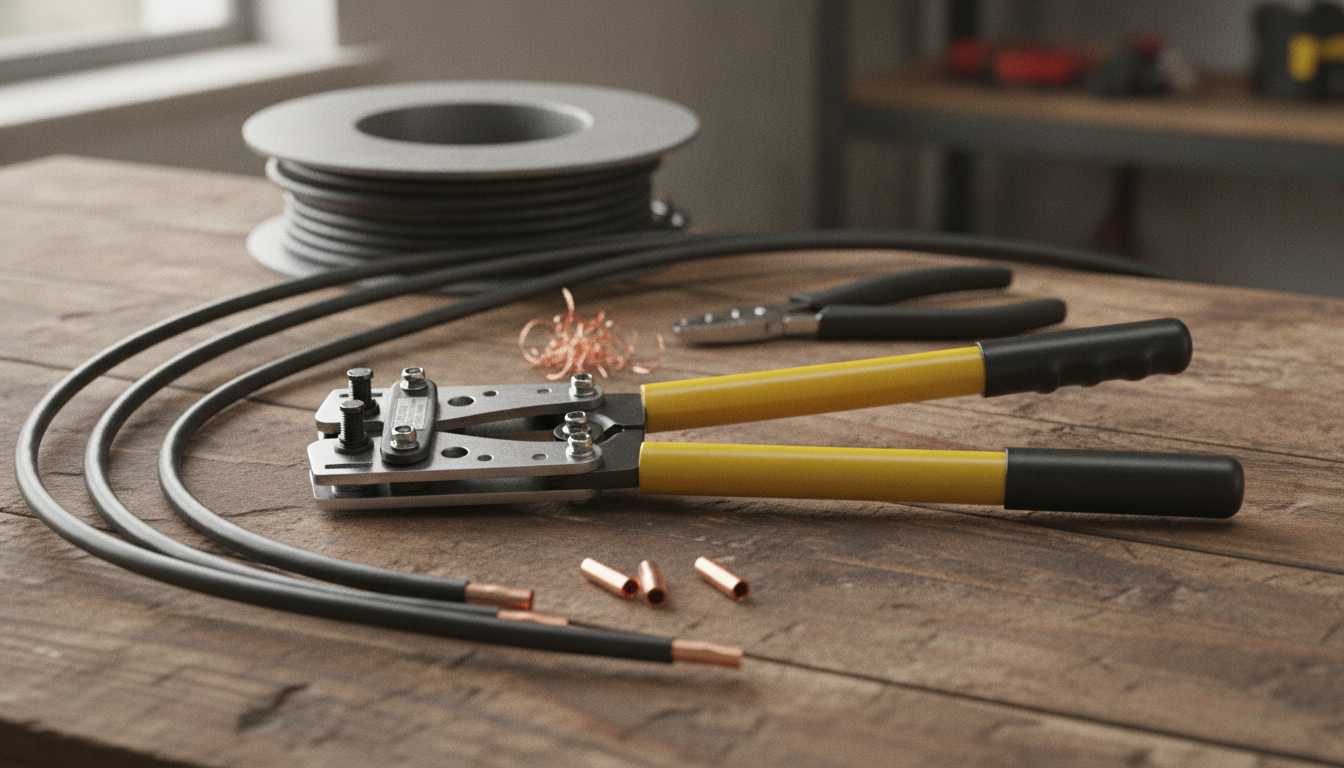
Reliable Crimps for Heavy Cable Work
For battery cables, inverters, winches, solar wiring, and industrial power runs, a reliable crimp is the difference between stable performance and heat, voltage drop, or failures. 6–50 mm crimp tube terminal crimper pliers are designed to form consistent compressions on large lugs and sleeves so cables stay secure under load and vibration. When the terminal, cable size, and die position are matched correctly, a properly executed crimp can deliver a strong mechanical bond and dependable electrical contact without the variability that comes from improvised methods.
What this tool is designed to crimp
- Crimp tube terminals and cable lugs commonly used on heavy-gauge conductors.
- Typical use cases: automotive battery leads, marine power distribution, solar/battery banks, generators, shop equipment, and high-current DC wiring.
- Supports a broad cable range (6–50 mm²), useful for mixed projects without swapping tools.
- Best results come from matching lug size, conductor size, and die position, then making a full-stroke crimp.
If the job regularly involves thick copper conductors, lug barrels with substantial wall thickness, or connections that must survive vibration, a purpose-built crimper helps avoid “almost-tight” connections that heat up over time.
Key features that matter for large-gauge crimping
- Wide crimp range: A broad size span helps reduce the need for multiple dedicated crimpers when working across several cable gauges.
- Mechanical advantage: Long handles increase leverage, making it easier to fully compress thicker terminals and sleeves.
- Die alignment and repeatability: Consistent alignment helps form uniform crimps that resist pull-out and reduce high-resistance hot spots.
- Workday practicality: For repetitive crimping, steady leverage and predictable compression help reduce hand fatigue and inconsistency.
Recommended in-stock gear
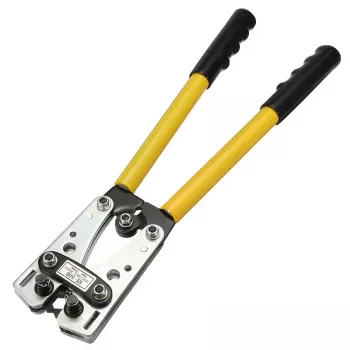
- 6-50 mm Crimp Tube Terminal Crimper Pliers
- Modern Abstract Face Storage Box (a handy way to keep lugs, heat shrink, and small install items together)
- 66W 5A Fast Charging Spring Retractable USB Type C Cable – For Car & On-the-Go (useful for powering devices in vehicles during installs and testing)
Choosing the correct terminal and cable pairing
- Match the conductor cross-section to the lug/sleeve marking (mm²): A loose barrel increases resistance and heat; an overfilled barrel can prevent full compression.
- Use fine-strand cable lugs for flexible conductors: Lugs intended for fine-strand cable improve fill and reduce strand damage during insertion and crimping.
- Use compatible metals: Select copper lugs for copper conductors; avoid mixing metals without properly rated connectors and anti-oxidation measures.
- Plan for the environment: For outdoor or marine installs, choose tinned copper lugs and adhesive-lined heat shrink to slow corrosion and seal the cable entry.
Quick fit and finish checklist
| Step | What to check | What good looks like |
|---|---|---|
| Strip length | Conductor exposure vs. barrel depth | Strands reach the barrel end with no bare wire outside after crimp |
| Lug size | Marking on lug/sleeve vs. cable | Cable fills barrel without forcing or slack |
| Die selection | Die position vs. lug size | Crimp forms centered and even, no severe flattening or sharp edges |
| Crimp completion | Full stroke applied | No partial crimp lines; consistent compression |
| Pull check | Manual tug on cable | No movement between conductor and terminal |
| Sealing | Heat shrink / insulation | Strain relief and moisture barrier where needed |
How to crimp a tube terminal cleanly (step-by-step)
- Cut and strip carefully: Cut the cable square. Strip insulation to match the lug barrel depth and avoid nicking strands, which can reduce ampacity and strength.
- Seat the conductor fully: Insert the conductor until it bottoms out in the barrel. If the cable is very fine-strand, a light twist can help keep strands together, but avoid over-twisting.
- Select the correct die position: Use the die position that matches the lug size marking. Place the barrel so the compression lands where the lug manufacturer intends.
- Crimp with a full, steady stroke: Apply smooth pressure to complete the compression. For long barrels, additional crimps may be appropriate—space them evenly rather than crushing repeatedly in one spot.
- Inspect and protect: Look for a centered, even crimp with no cracks and no sharp edges. Add heat shrink for insulation and strain relief, especially where movement or moisture is expected.
For guidance on accepted practices and performance expectations for solderless connections, consult standards and safety guidance such as UL 486A-486B and general electrical safety practices from OSHA.
Avoiding common failure modes
Care, storage, and long-term consistency
When to use a different crimping solution
FAQ
What does 6–50 mm² mean on a crimper?
It refers to the conductor cross-sectional area the tool is intended to crimp, measured in square millimeters. Always match the lug or sleeve marking to the cable size for a tight, fully compressed connection.
How can a crimp be checked for quality without special test equipment?
Check for an even, centered compression with no cracks or sharp edges, then do a firm pull test to confirm nothing slips. Also verify there’s no exposed bare wire outside the barrel and the lug sits flat on the stud without twisting the cable.
Should solder be added after crimping a heavy lug?
A properly executed crimp is typically sufficient on its own. Adding solder can wick into the cable, creating a rigid section that may fatigue under vibration; sealing with adhesive-lined heat shrink is often a better choice for protection.
Recommended for you
Weekender Duffle Size for a 2–3 Day Trip (35–45L)
Jul 24, 2026













Leave a comment